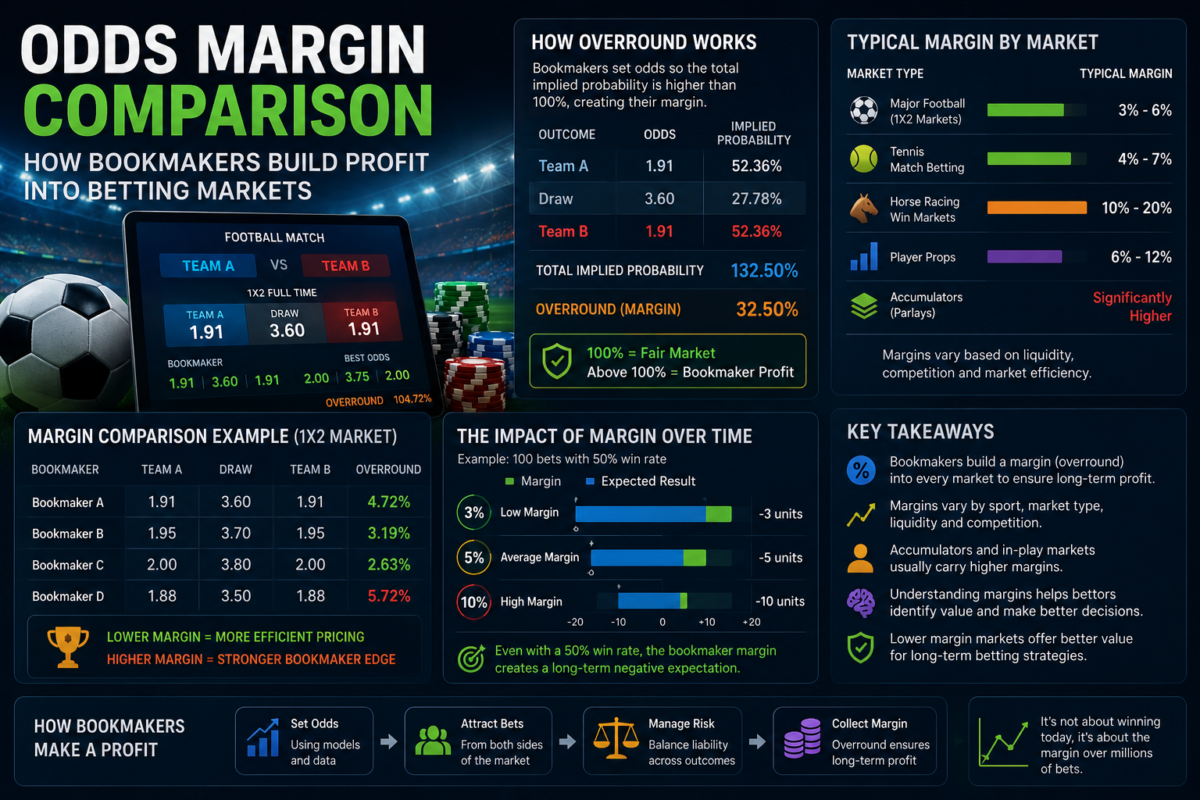
Odds Margin Comparison: How Bookmakers Build Profit Into Betting Markets
Bookmaker profit margins remain one of the most important structural components of the global betting industry. While betting odds appear straightforward on the surface, every regulated sportsbook incorporates mathematical margins designed to ensure long-term profitability.
This report explores how betting margins work, how they vary across markets and why pricing efficiency plays a central role in sportsbook economics.
What Is a Bookmaker Margin?
A bookmaker margin – often referred to as the “overround” – represents the built-in mathematical advantage embedded within betting odds.
In a perfectly fair market without operator profit, the implied probabilities of all outcomes would total exactly 100%.
However, bookmakers deliberately price markets above this threshold to secure theoretical long-term revenue.
For example:
| Outcome | Fair Odds | Bookmaker Odds |
|---|---|---|
| Team A | 2.00 | 1.91 |
| Team B | 2.00 | 1.91 |
The reduced payout creates a margin that generates operator profitability over time.
How Overround Works
The overround is calculated by converting all betting odds into implied probabilities and summing the total.
Example:
- 1.91 odds = 52.36% implied probability
- 1.91 odds = 52.36% implied probability
Total:
104.72%
The excess above 100% represents the sportsbook’s theoretical edge.
This structure ensures that bookmakers maintain positive expected value across large betting volumes.
Margin Levels Vary Across Betting Markets
Not all betting markets carry the same margin levels.
Generally:
| Market Type | Typical Margin |
|---|---|
| Major football match markets | 3% – 6% |
| Tennis match betting | 4% – 7% |
| Horse racing | 10% – 20% |
| Player props | 6% – 12% |
| Accumulators | significantly higher effective margin |
Highly liquid markets usually feature tighter pricing because competition between operators is stronger.
Smaller or niche markets often contain wider margins due to lower liquidity and higher pricing uncertainty.
Accumulators Generate Higher Effective Margins
Accumulator betting remains one of the most profitable product categories for sportsbooks.
Because multiple selections are combined, margin compounds across each leg of the wager.
Example:
- Single market margin: 5%
- Four-leg accumulator: substantially higher combined theoretical edge
This creates a significantly stronger long-term advantage for bookmakers compared to standard single bets.
Accumulators also benefit from recreational player popularity due to the appeal of large potential payouts.
Live Betting Markets Often Carry Wider Margins
In-play betting environments frequently contain higher operator margins than pre-match markets.
Several factors contribute to this:
- rapid odds adjustments
- increased volatility
- reduced player reaction time
- behavioural impulsivity
- lower price comparison activity
Because live markets move continuously, sportsbooks can maintain stronger pricing control while users prioritise speed over efficiency.
Market Competition Influences Pricing Quality
The level of operator competition directly impacts margin compression.
In highly competitive regulated markets such as:
- the United Kingdom
- Ontario
- major European football markets
operators often reduce headline margins to attract active bettors.
However, sportsbooks compensate through:
- accumulator products
- same-game parlays
- in-play betting
- niche markets
- promotional structures
This creates a balance between competitive pricing and profitability optimisation.
Sharp Bettors and Pricing Efficiency
Professional bettors often target markets where margins are lower and pricing inefficiencies exist.
Characteristics of sharper betting environments include:
- high market liquidity
- faster odds correction
- smaller operator edge
- stronger analytical pricing models
Sportsbooks increasingly rely on advanced risk management systems to minimise exposure against sophisticated bettors.
Data Analytics Drive Modern Odds Pricing
Modern sportsbooks utilise highly advanced analytical infrastructure to manage odds and margins.
Core analytical areas include:
- predictive modelling
- real-time data feeds
- automated pricing algorithms
- risk exposure balancing
- behavioural market analysis
Odds are no longer adjusted purely by human traders. Modern betting markets rely heavily on algorithmic pricing systems capable of reacting instantly to betting activity and external information.
Why Margins Matter for Recreational Bettors
Many casual users underestimate the long-term effect of betting margins.
Even small differences in pricing efficiency can significantly impact long-term returns.
For example:
- 3% margin markets are generally more bettor-friendly
- 10%+ margin environments substantially increase expected losses
Over extended betting periods, pricing quality becomes one of the most important factors influencing bettor sustainability.
Future Trends in Sportsbook Margin Strategy
The betting industry is expected to continue evolving toward increasingly data-driven pricing systems.
Future developments may include:
- AI-enhanced odds modelling
- real-time behavioural pricing adjustments
- personalised market structures
- dynamic margin allocation
- automated exposure balancing
As competition intensifies, operators will likely continue reducing margins in major markets while increasing monetisation through engagement-heavy products.
Conclusion
Bookmaker margins remain the financial foundation of the sports betting industry. Through overround pricing structures, sportsbooks secure long-term profitability across betting markets.
Margin levels vary significantly depending on market liquidity, competition and product type. While highly competitive markets feature tighter pricing, products such as accumulators and live betting continue generating stronger operator edges.
Understanding sportsbook margin structures provides valuable insight into betting economics, player outcomes and long-term market behaviour.